Which German work visa fits you? A route-by-route answer
Facts as of 09/2026 · re-checked at least every 6 months · by Benjamin Farmer
The short answer
Five routes cover almost everyone. With a degree and a job paying at least 50,700 euros in 2026 — 45,934.20 in shortage occupations — the EU Blue Card under § 18g is usually the strongest. With a recognised vocational qualification it is § 18a, with a comparable degree and lower pay § 18b; both are legal entitlements once the conditions are met. Without a degree but with two years of relevant experience from the last five and 45,630 euros, § 19c (2) can work. Without any job offer, the Chancenkarte under § 20a gives you a year to search. Nationals of six Western Balkan states have a route that skips recognition entirely.
- EU Blue Card (§ 18g)
- 50,700 € in 2026 — 45,934.20 € in shortage occupations or within 3 years of graduating
- Blue Card without a degree
- IT and ICT roles (ISCO 133, 25) with 3 years' experience from the last 7
- § 18a / § 18b
- recognised vocational qualification or comparable degree — any qualified job
- § 19c (2) + § 6 BeschV
- 2 years' experience from the last 5, at least 45,630 € in 2026
- Chancenkarte (§ 20a)
- no job offer needed — 6 points, 1 year, 20 hours' work per week
- Western Balkans (§ 26 (2) BeschV)
- any job, no recognition — capped at 50,000 approvals a year
- Age 45 and above
- salary of at least 55,770 € in 2026, or proof of pension provision
- National visa fee
- 75 € — accelerated employer procedure 411 €
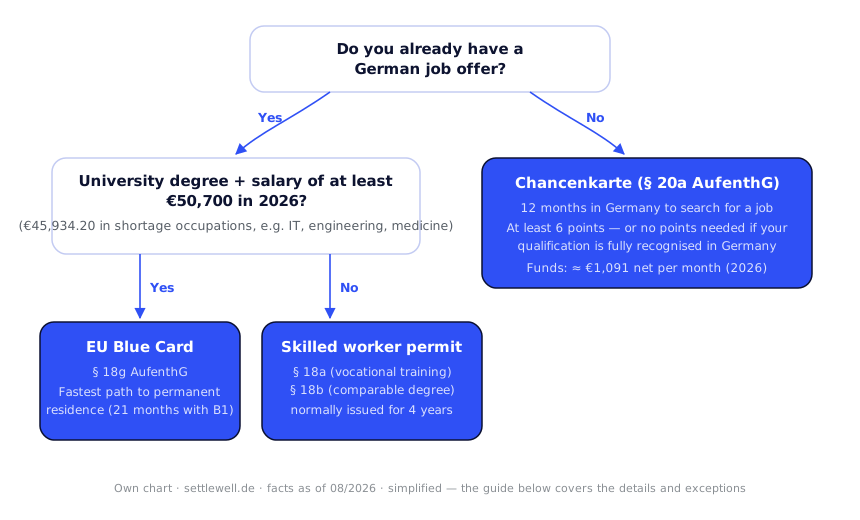
First, the honest answer: settle the paper question before the visa question
Almost every route below stands or falls on one line in § 18 (2) no. 4 AufenthG: the equivalence of your qualification must have been *established*, or your foreign degree must be a recognised one. Nothing else in the file substitutes for that.
So the useful order is not "which visa do I apply for" but "what does my certificate count as in Germany, and who says so". Get that answered first — through the recognition procedure for vocational qualifications, or through anabin and the ZAB for degrees — and the route usually picks itself. Do it the other way round and you will spend months on an application that was never open to you.
There is one group this does not apply to at all: citizens of the EU, the EEA and Switzerland. Under § 2 FreizügG/EU they may live and work in Germany as employees without any of these permits.
What every employment permit asks for
Before the routes diverge, § 18 (2) sets conditions that apply across all of them:
- a concrete job offer — not a promise, not a shortlist
- the Federal Employment Agency's approval, unless a law or regulation makes it unnecessary
- a professional practice licence where the job is regulated (nursing, medicine, many trades)
- established equivalence of your qualification, or a recognised foreign degree
- a declaration from you and the employer that the job will actually be performed as described
- if you are 45 or older: gross pay of at least 55 % of the pension contribution ceiling — 55,770 euros in 2026 — or evidence of adequate pension provision
If you hold a university degree
The EU Blue Card (§ 18g) is the route most graduates should check first. The standard threshold is 50 % of the annual pension contribution ceiling, which is 50,700 euros in 2026, and at that level the Federal Employment Agency is not involved at all.
A reduced threshold of 45,934.20 euros applies in two situations, both of which do need the agency's approval: you work in one of the occupational groups the law lists by ISCO-08 code — managers in ICT, production and specialised services, and professionals in science, engineering, health, teaching, business and IT — or you obtained your degree no more than three years before applying. The job offer itself has to run for at least six months.
There is a version of the Blue Card for people with no degree at all, and it is regularly missed. Under § 18g (2) an IT specialist or ICT manager (ISCO groups 25 and 133) can be issued a Blue Card on the strength of at least three years of relevant professional experience acquired in the last seven, provided the level is comparable to a degree and the salary reaches 45,934.20 euros.
If the degree is comparable but the salary is not there, § 18b applies instead. It is not a consolation prize: like § 18a it is written as an entitlement — "wird erteilt", *shall be granted* — and it permits any qualified employment, whether or not it relates to what you studied.
If your training was vocational
§ 18a covers skilled workers with vocational training, and it too is an entitlement rather than a discretionary decision. The condition that decides your case is the one from § 18 (2): the competent body must have established that your qualification is equivalent to the German one.
If the answer comes back as partial equivalence, the door is not shut. § 16d exists for exactly that situation — a residence permit to complete the adaptation measures, issued for up to 24 months, extendable by a further twelve, with a maximum stay of three years, and it allows unrelated side work of up to 20 hours a week.
If you have the experience but not the matching certificate
§ 19c (2) AufenthG, filled in by § 6 BeschV, is the route for pronounced practical knowledge. It asks for at least two years of relevant professional experience acquired within the last five years, a state-recognised foreign qualification of at least two years' training (or a degree, or a certificate from a German chamber of commerce abroad), and pay of at least 45 % of the contribution ceiling — 45,630 euros in 2026 — unless your employer is bound by a collective agreement.
Information and communication technology is treated differently here: IT professionals are exempt from the qualification requirement altogether.
One word in the statute is worth noticing. § 19c says the permit *may* be granted, where §§ 18a and 18b say it *shall be*. This is a discretionary route, and it behaves like one.
If you have no job offer yet
The Chancenkarte (§ 20a) is the only route on this page that does not require an employer. It is granted either because you already qualify as a skilled worker, or because you reach the points threshold — and the threshold is not a matter of interpretation: the annex to the Residence Act states that six points are needed.
It is issued for up to one year and lets you work an average of 20 hours a week, plus trial employment of up to two weeks at a time. You must show your living costs are covered; the Foreign Office works with 1,091 euros a month, so 13,092 euros for a twelve-month stay, typically through a blocked account or a formal declaration of support. On the points route you also need basic German or English at B2.
Once you have a contract and the employment agency agrees, it can be extended by up to two years as a follow-up Chancenkarte — but only if you do not already meet the conditions for a proper work permit, which by then you usually do.
Two routes that only apply to some people, and are worth the check
Citizens of Albania, Bosnia and Herzegovina, Kosovo, Montenegro, North Macedonia and Serbia can be approved for *any* employment under § 26 (2) BeschV — no recognition procedure, no skilled-worker status. The application has to be filed at a German mission in one of those countries, approvals are capped at 50,000 per calendar year, and anyone who received benefits under the Asylum Seekers' Benefits Act in the 24 months before applying is excluded.
Nationals of Australia, Israel, Japan, Canada, the Republic of Korea, New Zealand, the United Kingdom and the United States do not need a visa before travelling: under § 41 AufenthV they may enter and then apply for the residence permit inside Germany, within 90 days of arrival.
What it costs, and the procedure employers can pay for
A national visa costs 75 euros (§ 46 (2) no. 1 AufenthV). Beyond that, the fees that matter are the recognition ones, not the visa ones.
If your employer is willing, § 81a AufenthG lets them run an accelerated skilled worker procedure on your behalf, with power of attorney. It costs 411 euros, paid by the employer, and it buys real deadlines: the mission must offer you a visa appointment within three weeks of the preliminary approval, and decide the application within three weeks of a complete file as a rule. Ask about it before you accept an offer — many employers do not know it exists. Matching people to employers who will run it is our side of the work, and it stays free for you because the employer pays our fee.
Common mistakes
- Choosing a route before your qualification has been assessed — § 18 (2) no. 4 gates nearly all of them.
- Assuming a degree alone opens the Blue Card, when the 50,700 euro threshold gates it just as firmly.
- Missing that IT and ICT roles can reach the Blue Card without any degree, on three years of experience.
- Reading § 19c (2) as an entitlement — the statute says the permit may be granted, not that it shall be.
- Turning 45 without checking the extra condition: 55,770 euros in 2026, or proof of pension provision.
- Applying for the Western Balkans route from outside the six countries — it must be filed at a mission there.
- Planning a Chancenkarte year without the 13,092 euros of covered living costs the mission will ask to see.
Free tool
Job chances check
Answer a few questions about your qualification and experience and see which German work route is realistic for you — free, no sign-up.

Benjamin Farmer
Executive German coach and licensed § 34d insurance broker in Bavaria. I coach international professionals on exactly these steps every week, and run a placement service that introduces them directly to German employers.
LinkedIn Free introductory callDisclaimer
This guide is general information for orientation — not legal, tax or insurance advice. Rules, fees and thresholds change; the facts above were last verified 09/2026 against the sources listed below and are re-checked at least every six months — monthly where the figures move. For decisions about your specific case, rely on the responsible authority or on qualified professionals. We do not give legal or tax advice — where your case needs it, we will arrange a review by an immigration lawyer or a tax adviser on request.
Sources: § 18 AufenthG — general conditions for employment permits · § 18g AufenthG — EU Blue Card · § 20a AufenthG — Chancenkarte · Annex to § 20a (3) no. 2, § 20b AufenthG — points table, six-point minimum · § 6 BeschV — employment with pronounced practical knowledge · § 26 BeschV — Western Balkans regulation · § 31a AufenthV — deadlines in the accelerated procedure · Federal Foreign Office — minimum salaries for work migration 2026