Blue Card or skilled worker visa? Which route is yours
Facts as of 08/2026 · re-checked at least every 6 months · by Benjamin Farmer
The short answer
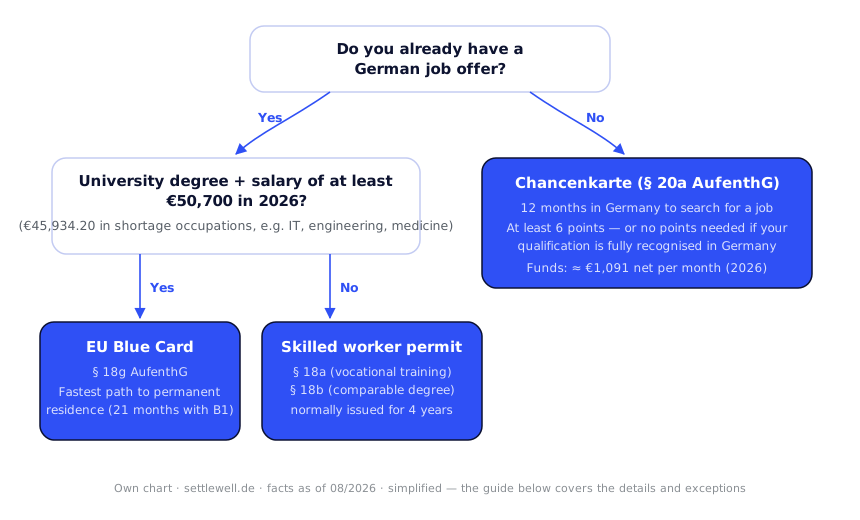
It depends on two things: what you studied or trained in, and what you will earn. The EU Blue Card (§ 18g) needs a university degree and a salary of at least 50,700 euros in 2026, or 45,934.20 euros in shortage occupations. Below those thresholds, or with vocational rather than academic training, you fall under the ordinary skilled worker permits: § 18a for a recognised vocational qualification, § 18b for a degree comparable to a German one. Both are normally issued for four years. One change matters for everyone: skilled workers may now take any qualified job — it no longer has to match the field you trained in.
- Skilled worker (definition)
- qualified vocational training or a university degree (§ 18 (3))
- § 18a
- vocational training — equivalence must be established
- § 18b
- academic — degree must be comparable to a German one
- § 18a / § 18b duration
- normally 4 years, unless the contract is shorter
- EU Blue Card (§ 18g)
- degree plus salary of 50,700 € (2026)
- Shortage occupations
- 45,934.20 € (2026)
- Blue Card family advantage
- spouse needs no A1 certificate (§ 30 (1) s. 3 no. 5)
Three routes, one definition underneath
German law starts from a single definition. Under § 18 (3) AufenthG a *skilled worker* is someone with either a qualified vocational training or a university degree. Which permit you apply for follows from which of the two you hold, and from what the job pays.
- § 18a. Skilled workers with vocational training
- § 18b. Skilled workers with academic training
- § 18g. The EU Blue Card
What each route asks you to prove
For § 18a, your foreign vocational qualification must have been assessed as equivalent to the German one. That is the recognition procedure, and for this route it is unavoidable.
For § 18b, your university degree must be comparable to a German degree — usually established via the anabin database or a ZAB statement rather than a full recognition procedure.
Both are normally granted for four years, unless your employment contract runs shorter.
The Blue Card and the numbers that gate it
The EU Blue Card under § 18g is the academic route with a salary condition attached: a university degree and gross pay of at least 50,700 euros in 2026, or 45,934.20 euros in shortage occupations. Miss the threshold and the Blue Card is simply closed to you, however good your degree.
It is not a niche title: at the end of 2025 the Blue Card was the most common residence permit held by foreign workers in Germany.
The advantage that decides more cases than salary does
If you are moving with a partner, one provision often outweighs the rest. A spouse joining an EU Blue Card holder is exempt from the A1 German requirement that otherwise applies before entry (§ 30 (1) sentence 3 no. 5 AufenthG).
In practice that can be the difference between your family arriving with you and your family arriving a year later, after a language course. People compare gross salaries and overlook this — it belongs in the same calculation.
The rule change that widened everything
One simplification now applies across the skilled worker routes: you may take any qualified employment. The job no longer has to relate to the field you trained or studied in.
That matters more than it sounds. A mechanical engineer can take a qualified role in logistics; a trained electrician is not confined to electrical work. If you were assuming your options were narrow, they are wider than they were.
Deciding, briefly
Take the Blue Card if you clear the degree and salary conditions — the family exemption alone usually justifies it. Take § 18b if you hold a comparable degree but the salary falls short, and § 18a if your background is vocational and your qualification has been recognised.
In every case you need a concrete job offer before applying. Finding the employer and getting the paperwork to line up is the part we take on; our work is free for you, and the employer pays our fee.
Common mistakes
- Assuming a degree alone qualifies you for the Blue Card, when the salary threshold gates it just as firmly.
- Overlooking the lower shortage-occupation threshold when your salary sits between the two figures.
- Comparing permits purely on salary and missing the Blue Card's exemption from your spouse's A1 requirement.
- Believing your job must match your field of training — that link was dropped for skilled workers.
- Starting a § 18a application before the equivalence of your vocational qualification has been established.
- Treating the four-year duration as guaranteed, when a shorter employment contract shortens the permit with it.
Free tool
Blue Card check
Four questions tell you whether the EU Blue Card is realistic for you and what would have to change — free, no sign-up.

Benjamin Farmer
Executive German coach and licensed § 34d insurance broker in Bavaria. I coach international professionals on exactly these steps every week, and run a placement service that introduces them directly to German employers.
LinkedIn Free introductory callDisclaimer
This guide is general information for orientation — not legal, tax or insurance advice. Rules, fees and thresholds change; the facts above were last verified 08/2026 against the sources listed below and are re-checked at least every six months — monthly where the figures move. For decisions about your specific case, rely on the responsible authority or on qualified professionals. We do not give legal or tax advice — where your case needs it, we will arrange a review by an immigration lawyer or a tax adviser on request.
Sources: § 18a AufenthG — skilled workers with vocational training · § 18b AufenthG — skilled workers with academic training · § 18g AufenthG — EU Blue Card · Make it in Germany — visa types for skilled workers