Job-seeker visa or Chancenkarte? What applies now
Facts as of 09/2026 · re-checked at least every 6 months · by Benjamin Farmer
The short answer
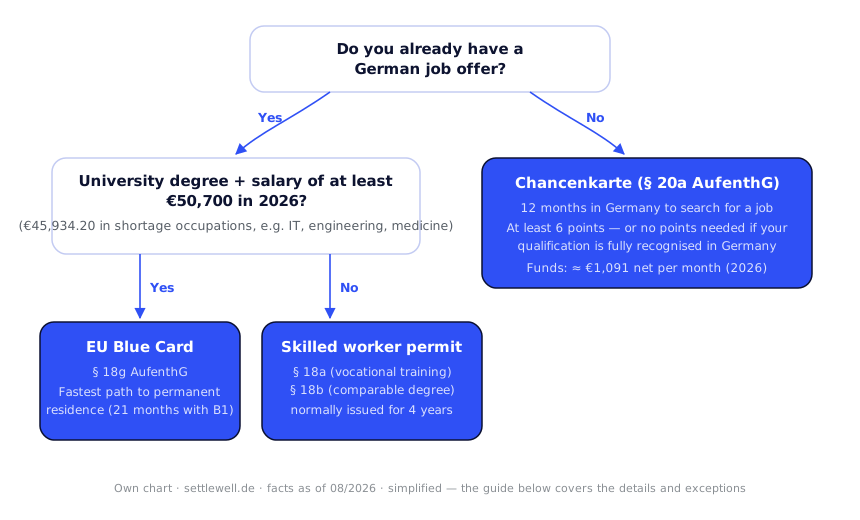
If you are applying from abroad, the Chancenkarte is Germany's job-search route — the former job-seeker permit under § 20 AufenthG for skilled workers entering from abroad was abolished on 1 June 2024. The Chancenkarte runs for up to twelve months, allows side work of up to twenty hours per week on average plus trial jobs of up to two weeks each, and requires either a fully recognised qualification, in which case no points are needed, or at least six points — plus proof of about 1,091 euros net per month (2026). Today's § 20 covers something different: job search after completing a degree, vocational training or qualification recognition in Germany, for up to eighteen months.
- Entry from abroad (today)
- Chancenkarte (§ 20a) — the former § 20 job-seeker route was abolished on 1 June 2024
- Chancenkarte duration
- up to 12 months, not renewable as such
- Extension path
- Folge-Chancenkarte: up to 2 more years with a contract or a binding job offer, plus Federal Employment Agency approval
- Points requirement
- none if your qualification is fully recognised in Germany; otherwise at least 6 of a possible 16 points
- Work allowed while searching
- up to 20 h/week on average, plus trial jobs of max. 2 weeks each
- Means of support (2026)
- ≈ 1,091 € net per month; visa fee 75 €
- § 20 AufenthG today
- job search only after studies, training or recognition completed in Germany — up to 18 months
The 2024 change many websites still miss
Until mid-2024, Germany had a job-seeker permit under § 20 AufenthG that let recognised skilled workers enter from abroad and search for up to six months. That route no longer exists: with the final stage of the Skilled Immigration Act, § 20 (1) and (2) were repealed on 1 June 2024 and replaced by the Chancenkarte (§§ 20a, 20b AufenthG).
Plenty of blog posts, agency pages and even official-looking checklists still describe the old six-month visa. If an adviser offers to apply for a "§ 20 job-seeker visa" for you from abroad, they are working from outdated law — a useful test of how current their knowledge is.
The Chancenkarte — the route from abroad
The Chancenkarte comes in two variants, and the difference decides how much paperwork you face. If your degree or vocational qualification is already fully recognised as equivalent in Germany, you qualify as a skilled worker and receive the Chancenkarte without any points check (§ 20a (3) no. 1 AufenthG).
If recognition has not happened yet, you need at least six points. The table in the annex to the Residence Act awards them like this — sixteen are possible, and there is more than one route to six:
- Partial recognition. 4 points, if the competent body has certified that adaptation measures or further qualification would close the gap
- German language. 3 points for B2, 2 for B1, 1 for A2 (only the highest level counts)
- English at C1. 1 point, awarded on top of any German points
- Work experience. 3 points for five years in the last seven, 2 points for two years in the last five
- Shortage occupation. 1 point, if your qualification belongs to one of the shortage groups under § 18g
- Age. 2 points up to 35, 1 point from 36 to 40
- Time already spent in Germany. 1 point for at least six months of lawful, uninterrupted stay in the last five years
- Spouse or registered partner. 1 point, if they separately meet the requirements and apply alongside you
What the Chancenkarte asks in return
Alongside the points you need German at A1 or English at B2, and either a vocational qualification of at least two years or a university degree recognised in the country where you obtained it. You must show means of support of about 1,091 euros net per month (2026 figure), typically via a blocked account. The visa fee is 75 euros, applied for at the German mission in your home country.
While searching you may work up to twenty hours per week on average in any job, and additionally take trial jobs of up to two weeks each with prospective employers. That is what makes the search financially survivable for most people.
After the year: the Folge-Chancenkarte
The search Chancenkarte itself runs for up to one year. If during that time you obtain either a qualified employment contract or a binding job offer for qualified work in Germany, and the Federal Employment Agency approves, it can be extended as a Folge-Chancenkarte for up to two further years (§ 20a (5) AufenthG). On that follow-up card the twenty-hour cap no longer applies, so you work your job normally while the longer-term residence title is sorted out.
One condition is easy to miss and mostly good news: the Folge-Chancenkarte is only granted if you do not already qualify for another residence title under section 4 of the Act. If your contract puts you over the EU Blue Card threshold, or you meet § 18a or § 18b, that is the title you get instead — a stronger one.
If the year ends with neither a contract nor a binding offer, the Chancenkarte is not simply renewable — which is why the search should start with a realistic plan, not just a flight.
What § 20 covers today — and who it is actually for
Today's § 20 AufenthG is titled "job search following stays in Germany". It applies to people who have just completed a German university degree, a qualified vocational training, a research stay or the recognition procedure here — they receive up to eighteen months to find a job matching their qualification (graduates of assistant-level health and care training: twelve months, extendable once by six).
So the two permits no longer compete. From abroad, the Chancenkarte is the route; § 20 is what you switch to after finishing your qualification inside Germany. If your qualification is already recognised, checking that first is worth it — it removes the entire points hurdle. That check costs you nothing — everything we do around work is free for you, because the employer pays our fee.
Common mistakes
- Following pre-2024 guides that still describe a § 20 job-seeker visa for entry from abroad — that route was abolished on 1 June 2024.
- Trusting an adviser who offers to apply for the old six-month job-seeker visa; the offer itself shows their information is outdated.
- Reaching six points but overlooking the separate minimums: A1 German or B2 English, and about 1,091 euros net per month.
- Counting only the obvious point categories. A shortage occupation, English at C1 on top of your German, six months spent in Germany years ago, or a partner who separately qualifies are worth one point each — enough to turn five points into six.
- Averaging more than twenty hours of side work per week on the search Chancenkarte.
- Not checking recognition first — a fully recognised qualification skips the points system entirely.
- Letting the search year run out with nothing in writing: the Folge-Chancenkarte needs a contract or a binding offer, and the Federal Employment Agency has to approve it.
Free tool
Chancenkarte check
Work out in a minute whether you reach the six points and what would move you over the line — free, no sign-up.

Benjamin Farmer
Executive German coach and licensed § 34d insurance broker in Bavaria. I coach international professionals on exactly these steps every week, and run a placement service that introduces them directly to German employers.
LinkedIn Free introductory callDisclaimer
This guide is general information for orientation — not legal, tax or insurance advice. Rules, fees and thresholds change; the facts above were last verified 09/2026 against the sources listed below and are re-checked at least every six months — monthly where the figures move. For decisions about your specific case, rely on the responsible authority or on qualified professionals. We do not give legal or tax advice — where your case needs it, we will arrange a review by an immigration lawyer or a tax adviser on request.
Sources: § 20 AufenthG — job search following stays in Germany (current text) · § 20a AufenthG — Chancenkarte (current text) · asyl.net — Chancenkarte and further changes in force since 1 June 2024 · Federal Foreign Office — Chancenkarte (visa navigator)